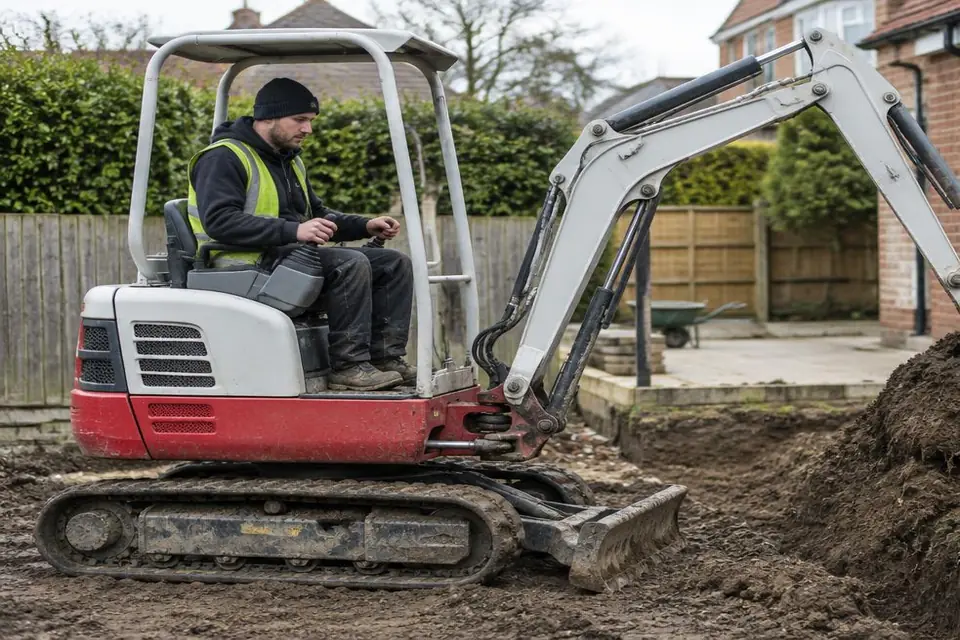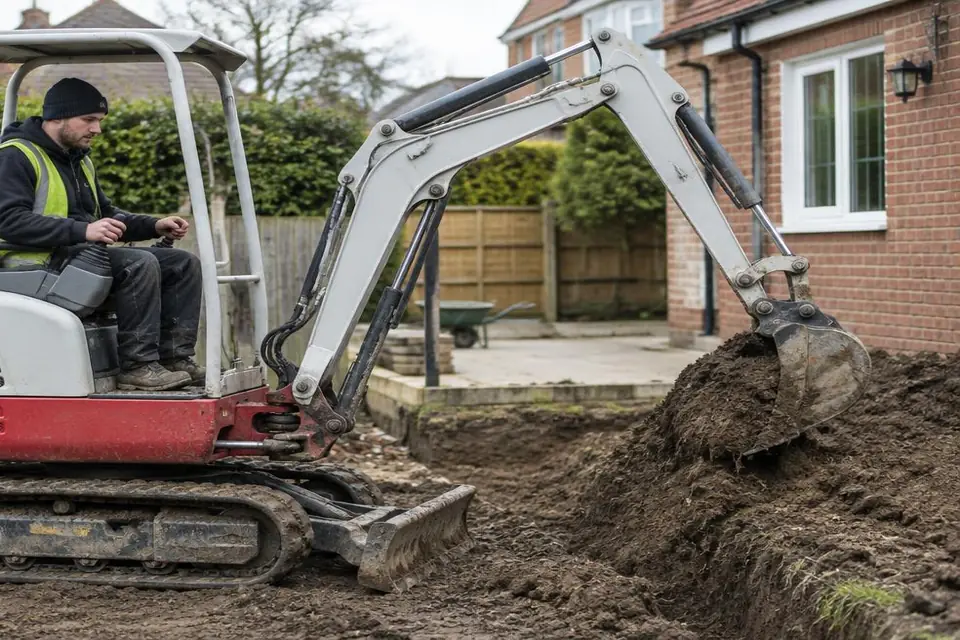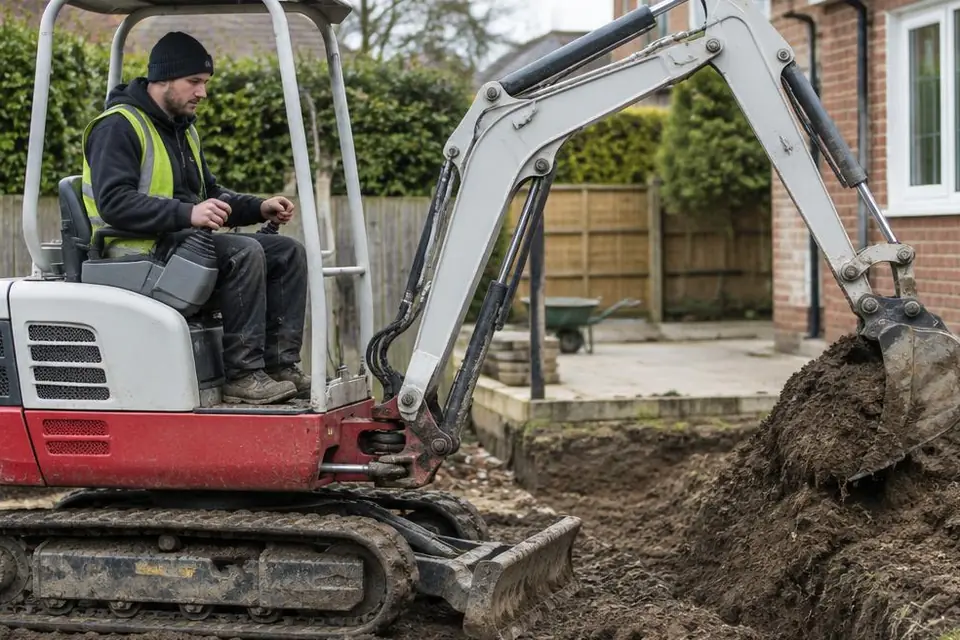
Landscapers, groundworkers, hire fleets, utilities contractors and sole traders usually arrive at the Kubota K008-3 for one reason: they need real digging capability in places a larger machine simply cannot reach. Garden gateways, cellar conversions, internal demolition, allotment paths, churchyards, narrow terraces and plant rooms all share the same constraint. The machine has to pass through a doorway, work quietly near people, and still shift enough material to make the day pay.
Direct answer: a new Kubota K008-3 in the UK is commonly guided in the high teens to low twenties of thousands of pounds before VAT, attachments, delivery and any dealer options, with used examples typically well below that depending on hours and condition. Exact pricing changes with specification and dealer stock, so treat every figure here as guidance and confirm the current price with a franchised Kubota dealer. Buckingham Leasing does not supply machines; we arrange the finance behind the purchase, from £5,000 to £5m, subject to status and credit acceptance.
What the Kubota K008-3 actually is
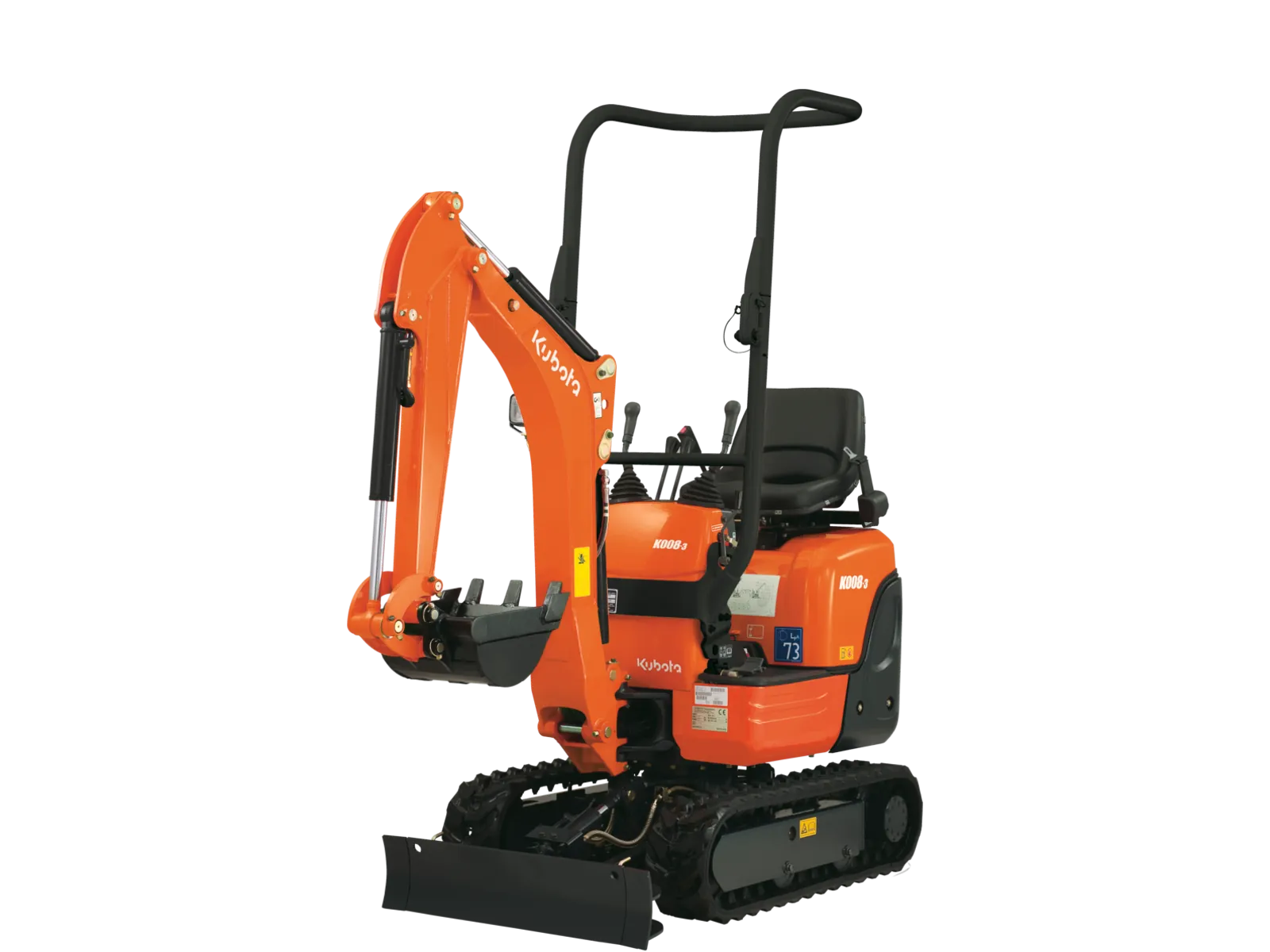
The K008-3 is Kubota's smallest conventional micro excavator, built around a 980kg operating weight and a three cylinder diesel engine producing around 10.2 horsepower. It sits in the sub one tonne class, which in practical UK terms means it can usually be moved on a braked trailer behind a suitable vehicle, lifted by a telehandler or crane where access demands it, and taken through a standard single doorway once the tracks are retracted and the blade removed or folded.
Variable width rubber tracks are the defining feature. Retracted, the machine narrows to a footprint that will fit through domestic gateways and corridors; extended, it regains the stability needed to dig and slew safely. That single design decision is what keeps the model on order books year after year, because very few other machines let one operator arrive, narrow the undercarriage in a couple of minutes, work inside a back garden and then widen again for open ground work on the same visit.
The folding canopy, low noise level and modest fuel burn matter as much as the digging numbers. On a residential street, a machine that idles quietly and does not smoke is a machine the neighbours tolerate. On an internal strip out, low emissions and small physical size determine whether the job can be mechanised at all or has to be done with a wheelbarrow and a breaker.
Kubota K008-3 new price in the UK: what shapes the number
There is no single national list price that stays true for long. UK dealers price against their own stock, exchange rate movements on imported machines, current Kubota promotions and the specification the buyer chooses. Broad guidance over recent years has placed a new K008-3 in the high teens to low twenties of thousands of pounds excluding VAT, with the cheapest quotes attaching to plain canopy machines on standard rubber tracks and one bucket, and the highest quotes covering machines with a full attachment package, hydraulic hitch and extras fitted before delivery.
Six things move that figure more than anything else. First, the attachment set: a three bucket package with a grading blade costs meaningfully more than a single digging bucket. Second, the hitch: a manual pin hitch is the cheapest route and a hydraulic quick hitch adds cost but saves minutes on every bucket change. Third, hydraulics: auxiliary circuits and a second service for a breaker or auger are worth having if you ever intend to hire the machine out. Fourth, tracks: rubber is standard, and steel track options or track protection change both the price and where the machine can work. Fifth, delivery and commissioning: some dealers include it, others itemise it. Sixth, timing: end of quarter and end of model year deals are real, and a dealer with stock standing still is a more flexible negotiator than one waiting on an order.
VAT sits on top of all of this at the prevailing rate. VAT registered businesses generally recover it in the normal way, subject to their own position, but the cash needs to be found up front on an outright purchase. That timing issue is one of the most common reasons buyers ask about hire purchase in the first place, because most funders advance the net cost and leave the VAT to be settled separately or funded within the agreement, depending on the product.
Indicative price bands and what sits behind them
| Condition | Indicative UK guidance, excluding VAT | What you are typically getting |
|---|---|---|
| New, base specification | High teens of thousands | Canopy machine, rubber tracks, one bucket, pin hitch |
| New, working specification | Around twenty thousand upwards | Three buckets, hydraulic hitch, auxiliary circuit, delivery |
| Nearly new, under 500 hours | A modest discount on new | Balance of warranty, dealer prepared, often ex demonstration |
| Used, 1,000 to 2,000 hours | Materially below new | Sound working machine, tracks and pins may need budgeting |
| Used, ex hire fleet | Lowest entry point | Hard worked, well serviced, cosmetic wear, check hours carefully |
These are bands, not quotations. The point of setting them out is to give a buyer a sense of whether the number in front of them is normal. If a new machine is being offered far below the bottom of the new band, ask what specification is missing and whether it is a grey import or a machine without UK dealer support. If a used machine is being offered close to new money, the hours and warranty need to justify it.
Specifications that matter on site
Headline specifications sell machines; working specifications finish jobs. The K008-3 carries an operating weight near 980kg, a three cylinder diesel around 10.2 horsepower, a travel speed of roughly 2kph and a variable undercarriage. In use, the numbers that decide whether it suits your work are dig depth, reach at ground level, dump height, slew offset and the retracted width.
Dig depth on this class of machine is usually enough for domestic drainage runs, footings for garden rooms, pond excavation, service trenches and root ball removal. It is not enough for deep foundation work or bulk muck shifting, and trying to force it into that role produces slow days and premature wear. Reach and dump height matter when loading a dumper or a grab lorry; if the machine cannot clear the side of the dumper you have hired, the job turns into double handling.
Retracted width is the specification that earns the money. Measure your real access, not the advertised one. Victorian side passages, timber gates with dropped hinges, and steps at the threshold routinely take out an inch or two that the plan drawing did not show. Many contractors carry a tape and a pair of scaffold boards for exactly this reason.
Working specification summary
| Area | Typical K008-3 figure | Why it matters |
|---|---|---|
| Operating weight | Around 980kg | Keeps the machine in the sub one tonne trailer and lifting class |
| Engine | Three cylinder diesel, around 10.2hp | Modest fuel burn, low noise, simple servicing |
| Travel speed | Around 2kph | Site tracking speed, not a transport speed |
| Undercarriage | Variable width rubber tracks | Narrow for access, wide for stability |
| Blade | Dozer blade, adjustable with the undercarriage | Backfilling, levelling and machine stability |
| Canopy | Folding ROPS canopy | Reduces transport height for low doorways and vans |
Always confirm current figures against the dealer specification sheet for the exact machine and build year you are quoted on. Manufacturers revise details between production runs, and an attachment or hitch can change effective dig depth and reach.
Who buys a K008-3 and why
Four buyer types dominate. Landscapers buy it because domestic gardens are the natural habitat of a sub one tonne machine and because clients increasingly expect mechanised groundwork on a two week job rather than three labourers with shovels. Groundworkers and drainage contractors buy it as a second machine, running alongside a three tonne or five tonne excavator so that the small one handles confined sections without tying up the big one.
Hire fleets buy it because micro excavators are among the most consistently hired items in the catalogue, moving to both trade and serious domestic customers, and because the low weight allows self collection on a trailer rather than a paid delivery. Utilities and property maintenance teams buy it for repeat access work: service repairs, cellar and basement work, internal strip outs, small demolition and reinstatement.
The common thread is repeatability. A machine that only comes out four times a year rarely justifies ownership, and hire is the cheaper answer. A machine that goes out weekly starts to make ownership arithmetic work, because the weekly hire rate on a sub one tonne excavator, once you add delivery and collection both ways, is often close to a monthly finance payment on a machine of your own.
Hire, buy or finance: doing the arithmetic honestly
Start with the number of weeks the machine will actually work, not the number of weeks you hope it will. Multiply that by the realistic all in hire cost, including transport in both directions, fuel, and the administrative time spent booking and returning. Compare it against the monthly cost of ownership, which is the finance payment plus servicing, insurance, tyres and tracks, wear parts and the eventual resale position.
A rough rule many contractors use is that ownership starts to look sensible somewhere around twelve to twenty weeks of annual utilisation, and becomes clearly sensible above that. Below that level, hire keeps the balance sheet clean and hands the risk of breakdown, damage and depreciation to somebody else. Above it, hire quietly becomes the most expensive way to own a machine.
The third option, and the one most buyers actually take, is to finance the purchase so that the machine pays for itself out of the work it does. That changes the comparison from a large single outflow against a stream of hire invoices, to a stream of finance payments against a stream of hire invoices, which is a far easier decision to make on paper and to defend to an accountant.
Finance options for a Kubota K008-3
Four routes cover almost every K008-3 purchase in the UK. Hire purchase spreads the net cost over a fixed term with a small option to purchase fee at the end, after which the machine is yours. Finance lease rents the machine over a primary period with a lower entry cost and a defined treatment at the end, which suits businesses that value payment efficiency over ownership. An operating lease or contract hire hands back the residual risk, which can be attractive where machines are replaced on a strict cycle. Asset refinance releases capital from machinery you already own outright, which is how a good number of K008-3 purchases are actually funded: the money comes out of a tractor, telehandler or van that is already paid for.
For a sub one tonne excavator bought by a contractor who intends to keep it for five or six years, hire purchase is the usual answer. The asset holds value reasonably well, the buyer wants title at the end, and capital allowances generally follow ownership. For a hire fleet replacing machines on a three year rotation, a lease structure often reads better, because the fleet cares about monthly cost per machine and resale timing rather than eventual ownership.
Whichever route you take, the funder assesses four things: the applicant, the affordability, the supplier and the asset. A recognised franchised dealer, a mainstream machine like the K008-3 and a clear invoice all make the credit decision easier. A private sale of an unusual import makes it harder, and sometimes impossible.
Comparing the finance products side by side
| Product | Ownership | Typical term | Best suited to |
|---|---|---|---|
| Hire purchase | Yours at the end, after the option fee | Two to five years | Contractors keeping the machine long term |
| Finance lease | Rented over a primary period, defined end treatment | Two to five years | Businesses prioritising monthly cost and VAT timing |
| Operating lease or contract hire | Returned at the end | Two to four years | Fleets on a fixed replacement cycle |
| Asset refinance | Capital released from owned machinery | One to five years | Funding a purchase without touching the bank facility |
| Unsecured business loan | No asset security | One to five years | Smaller top ups, attachments, delivery and set up costs |
Finance is available subject to status and credit acceptance, and all applicants must be 18 or over. Figures quoted by any funder are correct at the time of issue and may change before documents are signed. Administrative fees apply. Monthly, quarterly, annual and bespoke payment profiles are available on request.
Deposit, term and how they change the total
Two levers do most of the work on any quotation. A larger deposit reduces the amount financed and therefore the monthly payment and the total charge for credit. A longer term reduces the monthly payment but increases the total paid, because interest accrues over more months. Neither is automatically right. The correct term is the one that matches the useful working life of the machine and the cash the machine generates.
On a micro excavator, a term beyond five years rarely makes sense, because you would still be paying for the machine well past the point at which tracks, pins, bushes and hydraulic hoses start to need money. On the other hand, a two year term on a machine that will work for eight years pushes payments up unnecessarily and can strangle cash in the first two years, which is exactly when a growing business needs breathing room.
A useful discipline is to write down the monthly payment you can service in a quiet month, not a busy one. Any business that can only afford the payment in August has bought a problem for January. Good funders and good brokers ask about seasonality for exactly this reason, and payment profiles exist to smooth it.
Tax and accounting treatment in outline
Hire purchase generally treats the business as the economic owner from the start, which normally means the asset appears on the balance sheet, capital allowances may be available on the capital cost, and the interest element is treated as a business expense. Lease treatment differs, with rentals typically deductible as a business expense and the accounting position depending on the lease type and the standards applied.
VAT treatment also varies between products, particularly around whether VAT falls due up front on the capital cost or is spread across the rentals. This is a real cash flow difference, not a technicality, and it is the single point most often misunderstood by first time buyers.
None of this is tax advice. Allowances, thresholds and rules change, and the right treatment depends on your own circumstances, your accounting period and your profitability. Speak to your accountant before you sign, and ask for the treatment to be modelled on the specific product being offered rather than on finance in general.
Running costs over a five year ownership period
Buyers focus on price and payment and then discover the running costs. On a machine like this, the recurring items are predictable and manageable, but they are not zero. Fuel is modest by excavator standards, which is one of the quiet advantages of a ten horsepower engine. Servicing follows the manufacturer schedule, with filters, oils and greasing at set hour intervals, and it is worth budgeting a main service annually even on low hours because time based deterioration is real.
Rubber tracks are the wear item that surprises people. They are consumed by kerbs, hard core, rebar and tight turns on abrasive surfaces, and a hard worked machine may need a set inside two or three years. Pins and bushes wear on high cycle work. Hydraulic hoses chafe and eventually leak. Buckets need teeth, and a hydraulic hitch needs its safety checks.
Insurance is cheap relative to the machine but theft risk is real on sub one tonne plant, because it is small enough to be lifted onto a flatbed in minutes. Tracker fitment, ground anchors, immobilisers and marked components pay for themselves in premium terms and in the probability of getting the machine back. Many finance agreements require comprehensive cover for the duration in any case.
Five year cost of ownership checklist
| Cost line | Frequency | Notes for a sub one tonne excavator |
|---|---|---|
| Finance payment | Monthly or quarterly | Fixed for the term on most hire purchase agreements |
| Fuel | Per working day | Low by excavator standards, red diesel rules depend on the work |
| Routine servicing | By hours and annually | Filters, oils, greasing, hose inspection |
| Rubber tracks | Every two to four years | Faster on abrasive surfaces and tight turning |
| Pins, bushes and wear parts | As required | High cycle work accelerates wear |
| Insurance | Annual | Theft risk is meaningful on small plant |
| Transport | Per job | Trailer, straps, plating and towing capacity |
| Attachments | One off, then wear | Buckets, breaker, auger, hitch maintenance |
Adding these up before purchase, rather than discovering them afterwards, is the difference between a machine that quietly makes money and one that feels like a burden every time an invoice lands.
Attachments and the hidden half of the price
A bare machine is not a working machine. Most K008-3 buyers end up with a digging bucket in the 300mm range, a wider bucket around 450mm, and a grading or ditching bucket for finishing. That trio covers the majority of domestic and light commercial work. Beyond that, the two attachments that transform what the machine can charge for are a hydraulic breaker for concrete and hardstanding, and an auger for fence posts, tree planting and small foundations.
Each attachment needs the right hydraulic service, the right flow and the right hitch. Buying a breaker that the machine cannot properly drive is a common and expensive mistake. So is buying attachments on a different hitch standard to the machine, which then needs adaptors that add weight and reduce reach.
From a funding point of view, attachments bought at the same time as the machine can normally be included in the same agreement, which is simpler and usually cheaper than funding them separately later. Buyers often forget to mention them when asking for terms, then have to go back and restructure. Put the whole invoice in front of the funder at the outset, including delivery and any dealer fitted extras.
Transporting a 980kg excavator legally
The sub one tonne class is popular partly because it is transportable without an HGV, but the rules still need respect. The combined weight of machine, trailer, buckets, fuel and any attachments must sit inside the towing vehicle's plated limits and the driver's licence entitlement. It is entirely possible to buy a machine that is legal to own and illegal for you to tow with your current vehicle and licence category.
A braked plant trailer with a ramp rated for the load, proper lashing points and four independent straps is the minimum. Blade down, boom parked, tracks retracted or extended according to the trailer bed, fuel cap locked and a wheel or track chock in place. Loose buckets in the back of the van rather than rattling on the trailer bed.
If you do not have a suitable towing vehicle, factor either the cost of one or the cost of a plant delivery service into your ownership arithmetic. Two collections a week by a third party can quietly turn a sensible purchase into a marginal one.
Buying a used K008-3 without inheriting somebody else's problem
Used sub one tonne excavators hold value well, which is good news at resale and painful at purchase. Because the demand is broad, weak machines sell too, so inspection matters. Check hours against condition: a 3,000 hour machine that has been serviced and kept inside will usually outlast a 1,200 hour machine that has lived in the open being hired to whoever turned up.
Look at the tracks first, then the idlers and rollers, then the pins and bushes for play at full reach. Run the machine through full slew, full boom travel and full dipper travel and watch for drift when you pause. Check the blade for straightness, the hoses for chafing, the canopy mounts for cracks and the undercarriage widening mechanism for smooth operation, because a seized variable undercarriage removes the entire reason for buying this model.
Ask for service records, ask who has owned it, and ask why it is being sold. On any machine bought privately, an HPI style check for outstanding finance is essential, because an asset with existing finance on it can be recovered from an innocent buyer. Funders are also far more comfortable lending against a dealer supplied used machine with a warranty than a private sale, and that comfort usually shows up as better terms.
New against used: how the numbers really compare
New buys certainty. A full warranty, no accumulated wear, current emissions compliance, a known service history from hour zero and a dealer relationship that matters when something goes wrong in week three of a job. It also buys the strongest finance terms, because funders price risk against the asset as well as the applicant.
Used buys capital efficiency. The steepest depreciation has already been absorbed by somebody else, and a well chosen three year old machine can do the same work for a materially lower monthly payment. The trade off is uncertainty and a higher probability of unbudgeted maintenance in year one.
A practical way to decide is to model both over the same holding period, including realistic maintenance for the used option and realistic resale for both. If the gap between them over five years is small, take the new machine for the warranty and the peace of mind. If the gap is large, take the used machine and put some of the difference aside for tracks and pins.
How the K008-3 compares with the alternatives
The sub one tonne class is crowded. Takeuchi, JCB, Yanmar, Bobcat, Hitachi and others all field machines in the same weight band, and most of them are competent. The differences that matter in practice are dealer support, parts availability, resale strength and the details of the undercarriage and canopy.
Kubota's advantage in the UK has generally been network depth and resale value. Parts tend to be available quickly, dealers are spread widely, and the brand carries well at auction and in dealer part exchange. That resale strength is not a vanity point: it lowers the real cost of ownership and it makes funders more relaxed, because the asset underpinning the agreement has a liquid secondhand market.
The honest counterpoint is that competitors sometimes offer more machine for the money on paper, particularly on dig depth or hydraulic flow. If your work is repetitive and specification driven, compare the actual numbers. If your work is varied and you value being able to get a part on a Tuesday morning, network strength usually wins.
Sub one tonne class comparison points
| Decision factor | What to check | Why it decides the purchase |
|---|---|---|
| Retracted width | Measured, not advertised | Determines whether the machine reaches the work at all |
| Dig depth and reach | Against your most common job | Undersized machines cost days, oversized machines cost access |
| Hydraulic services | Flow and number of circuits | Decides which attachments will actually work |
| Dealer network | Distance and parts stock | Downtime cost usually exceeds price difference |
| Resale history | Auction and dealer values | Lowers true cost of ownership and improves finance terms |
| Transport weight | With buckets and fuel | Keeps the machine legal behind your vehicle |
Applying for finance: what a funder wants to see
For smaller facilities, many funders work from limited information: company details, the proposal, a credit search and sometimes a director guarantee. As the facility size rises, or where trading history is short, the requirements grow. Being ready shortens the process from days to hours.
Have the supplier invoice or written quotation, showing the machine, specification, attachments, delivery and VAT separately. Have your most recent filed accounts and, where trading has moved on since, recent management figures. Have three to six months of business bank statements available. Have details of existing finance commitments, because funders will see them on the search anyway and a clean disclosure reads far better than a discovered omission.
Sole traders and newer businesses should expect more questions, not a closed door. Evidence of contracted work, a deposit, a home owning guarantor or a strong personal credit record all help. Adverse credit does not automatically end the conversation either; it changes which funders will look and at what rate, which is precisely the situation where a broker with a panel earns their fee.
How quickly a K008-3 purchase can complete
For a straightforward proposal on a mainstream machine from a franchised dealer, a decision often comes back the same day or the next working day. Documents are usually electronic. Payout to the dealer follows acceptance of the documents and, in most cases, confirmation that the machine is ready for collection or delivery.
The practical timeline is therefore governed less by the finance and more by the dealer's stock position. A machine on the floor can be working within the week. A machine on order can be months away, and it is worth asking bluntly whether the quoted price is protected if delivery slips into a new price list.
Where the proposal is more complex, because the business is new, the machine is a private sale, or the facility is larger, add a few days for information gathering. The delays that bite are almost always missing paperwork rather than credit decisions.
Ten mistakes buyers make with micro excavator finance
First, buying on monthly payment alone without looking at the total payable and the term. Second, leaving attachments out of the agreement and funding them badly later. Third, forgetting the VAT timing and then scrambling for cash in the first month. Fourth, taking a term longer than the sensible working life of the machine. Fifth, ignoring seasonality and setting a payment that only works in a good month.
Sixth, buying privately without a finance and theft check. Seventh, choosing a machine that cannot legally be towed by the vehicle already on the fleet. Eighth, specifying hydraulics that will not drive the breaker the business intends to use. Ninth, allowing multiple funders to run hard credit searches in the same week, which leaves a trail that looks like distress borrowing. Tenth, not asking what happens at the end of the agreement, particularly on lease products where the end treatment is the whole point.
Every one of these is avoidable with a conversation before the order is placed rather than after. The cost of getting it wrong is rarely catastrophic, but it is almost always irritating for the length of the agreement.
Putting a K008-3 into a hire fleet
Hire operators judge machines on utilisation, damage rate and cost per hire day. The sub one tonne class scores well on the first, because it goes out to trade and to competent domestic customers and because it can be collected on a trailer rather than delivered by lorry. It scores less well on damage rate, because inexperienced operators find kerbs, gateposts and buried services.
The counter measures are familiar: robust handover instructions, a photographic condition record at both ends, track protection where appropriate, and an honest damage waiver policy. On the funding side, fleets usually prefer structures that align the payment period with the planned rotation, so that the machine is disposed of while it is still desirable and before the maintenance curve turns upwards.
Fleet finance also rewards planning. Funders will often set up a facility covering several machines over a year rather than treating each purchase as a fresh application, which cuts administration and gives the fleet manager certainty at ordering time.
Sector by sector: where the machine earns its keep
In domestic landscaping, the K008-3 turns a labour job into a machine job. Ponds, patios, levelling, drainage, root removal and hard core preparation all become faster, and clients increasingly expect it. In groundworks, it complements rather than replaces the three tonne machine, working in confined corners and against boundaries where the larger machine cannot slew.
In property maintenance and internal works, the folding canopy and narrow undercarriage open up cellars, courtyards, plant rooms and behind terraced properties. In utilities and reinstatement, the machine handles service trenches, small excavations and backfilling in places where a vehicle mounted solution cannot park. In agriculture and equestrian work, it does yard drainage, fence post work with an auger, and small building maintenance without churning up ground the way a heavier machine would.
Across all of these, the financing logic is the same. The machine should be paid for over roughly the period during which it will generate the revenue that funds it, and the payment should be comfortable in a quiet month.
Resale and what the machine is worth at the end
Micro excavators from mainstream brands hold value comparatively well because demand is broad and the buyer pool is deep: contractors, hire fleets, farms, estates and private buyers all compete for the same used machines. Condition, hours and completeness of service history drive the number, and an original set of buckets with a working hitch adds more than people expect.
Three things protect resale during ownership. Keep the service book current and stamped. Keep the machine clean and stored inside where possible, because rubber, seals and paint all deteriorate faster in the open. Replace worn tracks before sale rather than discounting for them, because buyers mentally overcharge for the job.
If you financed on hire purchase and you own the machine at the end, the resale value is simply yours. If you leased, the end treatment was agreed at the outset and the residual risk was priced accordingly. Neither is better in the abstract; they are different ways of deciding who carries the uncertainty about what a used machine is worth in four years' time.
A practical pre purchase checklist
Measure the narrowest access on your three most common job types. Confirm the retracted width and transport height of the exact machine being quoted. Confirm the attachment list, hitch type and hydraulic services against the attachments you intend to use. Get the invoice broken down by machine, attachments, delivery and VAT.
Confirm your towing vehicle's plated capacity and your licence entitlement against the loaded trailer weight. Check insurance cost and any security requirements before signing, not after. Ask the dealer what the service intervals are and what a main service costs. Ask what the lead time is and whether the price is held if delivery slips.
Then, on the funding side, agree the term against the working life of the machine, check the total payable as well as the monthly figure, confirm the end of agreement position in writing, and make sure your accountant has seen the product type before the documents are signed.
What a broker adds on a purchase this size
On a sub one tonne excavator, the sums are small enough that some buyers assume a broker is unnecessary. In practice the value is in matching the proposal to the right funder first time. Funders have appetites: some like new machines from franchised dealers, some are comfortable with used and private sales, some specialise in newer businesses, and some will not look at a particular sector at all.
Going direct to a bank and being declined does not simply cost time; it leaves a search footprint and can make the next application harder. A broker places the proposal where it is most likely to be accepted and presents it in the form the credit team expects. That is the whole job, and it is why a well presented application on a mainstream machine usually comes back quickly.
Buckingham Leasing is an FCA authorised broker arranging asset finance from £5,000 to £5m for UK businesses. We do not supply machines. We work alongside franchised dealers and fund the purchase behind them, with hire purchase, lease and refinance options, and with monthly, quarterly, annual or bespoke payment profiles on request. Finance is subject to status and credit acceptance, and all applicants must be 18 or over.
Questions buyers ask about the K008-3
What is the new price of a Kubota K008-3 in the UK? Guidance in recent years has generally sat in the high teens to low twenties of thousands of pounds before VAT for a new machine, with the final figure depending on attachments, hitch, hydraulics, delivery and dealer promotions. Confirm current pricing with a franchised dealer.
Can I finance a used K008-3? Yes. Funders routinely finance used machines, with the age and hours affecting term and rate. A dealer supplied machine with warranty attracts better terms than a private sale, and any private purchase should be checked for outstanding finance first.
How much deposit do I need? Anything from nil to a substantial percentage, depending on the funder, the business and the asset. A deposit lowers the monthly payment and the total charge for credit, and it can unlock terms for a newer business.
What term should I choose? Match the term to the working life and the revenue the machine generates, commonly three to five years on a micro excavator. Longer terms lower the payment but raise the total paid.
Will the machine fit through a standard doorway? With the tracks retracted and the canopy folded, a sub one tonne machine of this type is designed for restricted access. Always measure the actual opening, including thresholds and hinge intrusion, before committing.
Do I own the machine at the end? On hire purchase, yes, once all payments and the option to purchase fee are made. On a lease, the end treatment is set out in the agreement, which may involve return, secondary rental or sale to a third party.
Can a new business get finance? Often yes, with support such as a deposit, a director guarantee, evidence of contracted work or a strong personal credit record. Expect more questions and a narrower set of funders rather than an automatic refusal.
How quickly can it be arranged? A straightforward proposal frequently receives a decision the same or next working day, with electronic documents and payout following shortly afterwards. Dealer stock availability is usually the longer part of the timeline.
Can attachments be included? Yes, and they normally should be. Including buckets, a breaker, an auger, a hitch and delivery on the same invoice keeps the funding simple and usually cheaper than arranging them separately later.
Is the K008-3 too small for my work? If most of your excavation is deep footings or bulk muck shifting, yes. If access is the constraint and the volumes are modest, it is close to ideal, and many contractors run one alongside a three tonne machine rather than choosing between them.
Summary
A new Kubota K008-3 in the UK is a high teens to low twenties of thousands of pounds proposition before VAT and options, with used machines materially cheaper and still capable. The machine earns its money on access: variable tracks, folding canopy and sub one tonne weight let it work where bigger machines cannot go. Ownership makes sense above roughly twelve to twenty weeks of annual use, and below that hire is usually cheaper.
Finance turns the decision from a capital question into a cash flow question. Hire purchase suits buyers who want ownership, lease structures suit fleets and payment efficiency, and refinance releases money from machinery already owned. Whichever route you take, match the term to the working life, include the attachments, budget for tracks and servicing, and check the total payable rather than the monthly figure alone.
Finance is available subject to status and credit acceptance, and all applicants must be 18 or over. Figures are correct at the time of printing but are subject to change before signing. Administrative fees apply. Buckingham Leasing Limited does not supply machines; we work closely with UK franchised dealers who specialise in machinery sales.
Emissions rules, engine standards and what they mean for price
Small diesel engines are governed by non road mobile machinery emissions rules, and successive stages of those rules have shaped what manufacturers can sell new. The practical effect for a buyer is threefold. New machines carry current compliance, which matters if you work on sites or in city zones where operators are asked to evidence engine standards. Older machines may be restricted from certain contracts, particularly on larger principal contractor sites in urban areas. And compliance costs sit inside the new price, which is part of why new machinery pricing has moved upwards over the last decade rather than downwards.
For a sub one tonne machine working mainly on domestic and light commercial jobs, this rarely stops a purchase. It becomes material the moment you start subcontracting to a principal contractor with a plant policy, or working inside a low emission construction zone. If any part of your pipeline points that way, buy with it in mind rather than discovering it at the gate.
Fuel rules are a related question. Entitlement to rebated fuel depends on the activity being carried out rather than the machine, and the rules have tightened considerably in recent years. Construction work generally uses full duty diesel, while certain agricultural and horticultural activities retain entitlement. Check your own position with your accountant or HMRC guidance, and keep the machine's usage records straight, because the burden of proof sits with the user.
Operator competence, safety and the paperwork that comes with it
A 980kg excavator is small enough to feel casual about and heavy enough to kill somebody. Operator competence matters, and on any commercial site you will be asked to evidence it. Recognised training and card schemes cover compact plant, and most principal contractors will want to see a card before the machine turns a track.
Before digging, the buried services question has to be answered. Utility plans, a cable avoidance tool, a signal generator and hand digging to expose services are the standard sequence, and skipping it is how contractors end up in front of an investigator. Sub one tonne machines do a lot of work in gardens and verges, which is precisely where unmapped supplies, old lead pipes and shallow cables live.
Then there is the routine discipline: exclusion zones around the slew radius, banksman where visibility is restricted, no passengers in the bucket, no lifting without the right rating and accessories, and daily pre start checks recorded rather than remembered. None of this is exotic, but it is the difference between an insurable operation and an uninsurable one, and insurers increasingly ask the question.
Security, theft and insurance on small plant
Sub one tonne machines are among the most stolen items of plant in the UK because they are valuable, portable and quick to sell. Theft usually happens overnight from an unattended site or from a trailer parked at a home address. The counter measures are boring and effective: a tracker with subscription maintained, a ground anchor and chain, wheel clamps on the trailer, a hitch lock, marked and registered components, and photographs of the machine and its serial numbers kept somewhere other than the van.
Insurers price on these measures, and finance agreements typically require comprehensive cover for the machine throughout the term with the funder's interest noted. Read what the policy actually covers: some policies exclude theft where keys are left with the machine, some exclude loss from an unsecured site after certain hours, and some limit cover while in transit.
If the worst happens, an insured machine with a live finance agreement produces a settlement to the funder first, with any balance to the business. That is another reason to keep the finance term aligned with value: a long term against a fast depreciating asset can leave a shortfall, and gap style protection exists precisely for that mismatch.
A realistic maintenance calendar
| Interval | Task | Why |
|---|---|---|
| Every day | Visual check, fluid levels, greasing, track tension glance | Catches leaks and damage before they become downtime |
| Weekly | Battery, hoses, pins for play, track debris removal | Abrasive debris is the main enemy of rubber tracks |
| By hours | Filters, oils, hydraulic service per manufacturer schedule | Protects the engine and hydraulics and preserves warranty |
| Annually | Main service even at low hours | Time based deterioration of seals, fluids and rubber |
| Two to four years | Rubber tracks, bushes, hitch overhaul | Standard wear items on a working machine |
| Before sale | Track replacement, full service, documentation | Buyers discount wear more heavily than it costs to fix |
The value of a written schedule is partly mechanical and partly commercial. A stamped book adds real money at resale and reassures any funder considering the machine as security on a future facility.
Regional and seasonal variation in what you will pay
Plant prices are not uniform across the UK. Dealer density, transport distances, local demand and the strength of the regional construction market all move quotations. A machine collected from a dealer forty miles away can be cheaper than the same machine delivered two hundred miles, once transport is itemised. Equally, a dealer with three unsold machines on the floor in a quiet month will price more keenly than one with a waiting list.
Seasonality is real too. Demand for compact plant tends to firm up in spring as external work restarts and soften in the depths of winter. Model year changes and manufacturer promotions create windows where a new machine is unusually competitive against an almost new used one. If your purchase is not urgent, asking your dealer when the next promotion is due can be worth several hundred pounds.
None of this justifies waiting indefinitely. A machine that would be earning is losing money while it is not bought. The sensible position is to be ready, know your numbers, have an agreement in principle, and move when the right machine appears at the right price.
A ten step decision framework
One: write down the work the machine must do, by job type and by frequency. Two: measure the tightest access you routinely face. Three: decide whether you need ownership or simply use, which drives hire against purchase. Four: estimate annual utilisation honestly in weeks. Five: price the hire alternative fully, including transport both ways.
Six: get two or three dealer quotations on like for like specification, including attachments, hitch, delivery and VAT shown separately. Seven: model the cost of ownership over five years, adding servicing, tracks, insurance and a contingency. Eight: decide new against used using the same holding period for both. Nine: choose the finance product that matches your ownership intention and your tax position, with your accountant's input. Ten: fix the term to the working life and check the total payable, not just the monthly figure.
A buyer who works through those ten steps rarely regrets the purchase. A buyer who starts at step six and stops there is the one who ends up with the wrong hitch, an awkward term and a machine that cannot get through the gate on the job that prompted the purchase in the first place.
Three scenarios in detail
The domestic landscaper in a city. Almost all work is behind terraced or semi detached houses, access is between 800mm and a metre, and spoil leaves by barrow and grab lorry. Here, retracted width and canopy height decide everything, dig depth is secondary, and a breaker earns more than an auger because of old concrete bases and paths. Ownership becomes sensible quickly because hire delivery into tight streets is expensive and slow.
The rural groundworker. Access is rarely the constraint; volume is. The K008-3 is the second machine, used for service trenches, tight corners, fencing and finishing, while the three tonne machine does the bulk. Utilisation is moderate but consistent, and a five year hire purchase term at a comfortable monthly figure matches how the machine will be used and kept.
The hire desk. Utilisation is the entire business case. The machine goes out fifty per cent or more of available weeks, damage is managed by policy, and the machine is rotated at three years while still desirable. A lease structure aligned to that rotation keeps cost per hire day predictable and avoids owning tired assets that nobody wants to hire.
Glossary of the terms you will meet
Balloon or final payment: a larger payment at the end of some agreements that lowers monthly cost during the term. Capital allowances: tax relief that may be available on the capital cost of qualifying equipment, depending on your circumstances. Documentation fee: an administrative charge applied by funders at the start of an agreement.
Hire purchase: a product where the business pays for the asset over a term and owns it at the end after an option to purchase fee. Finance lease: a rental over a primary period with a defined end treatment rather than automatic ownership. Operating lease or contract hire: use of the asset for a period with return at the end and residual risk carried by the funder.
Option to purchase fee: the small final sum that transfers title on a hire purchase agreement. Refinance: raising funds against machinery already owned outright. Residual value: the value of the asset assumed at the end of the term. Total payable: the sum of all payments and fees across the agreement, the figure to compare between quotes.
Next steps
If you are pricing a Kubota K008-3, get the dealer quotation broken down, measure your access honestly, and then look at the funding once you know exactly what you are buying. If it would help to see how the payments look against hire purchase, finance lease or refinance, we can set the options out side by side before you commit to anything.
Buckingham Leasing arranges asset finance for UK businesses from £5,000 to £5m across agriculture, groundscare, construction and general plant, working alongside franchised dealers rather than supplying machines ourselves. You can read more about hire purchase, finance lease and asset refinance, review our finance products, browse construction and plant finance, or contact the broking desk.
Finance is available subject to status and credit acceptance, and all applicants must be 18 or over. Buckingham Leasing Limited is authorised and regulated by the Financial Conduct Authority. Figures in this guide are indicative and for illustration only; confirm current machine prices with a franchised Kubota dealer and confirm tax treatment with your accountant.
Further detail on funding the purchase
Start with the business decision
Direct answer: Kubota k008-3 is a way to match the cost of Kubota K008-3 micro excavator to the period it works for the business. The suitable route depends on ownership, security, cash flow, tax treatment and useful life. A funder still assesses affordability, the applicant, supplier and asset before offering terms.
Apply the principle to this purchase
The useful starting point is not a product name. It is the operational result the business needs and the risk created by delay. Describe the present constraint, the expected improvement, the purchase timetable and the downside if the investment does not proceed. This gives a broker and funder a commercial case rather than a bare request for money. For Kubota K008-3 micro excavator, the working case is a sub-one-tonne excavator purchase where width, transport and steady utilisation are central. Kubota K008-3, Takeuchi TB210R and Bobcat E10 are useful market entities rather than endorsements. Exact model, condition and supplier support remain more important than a badge on the bonnet or casing.
Landscapers, groundworkers, hire fleets and sole traders working with restricted access should write down what changes after delivery, how that change will be measured and what happens if demand or savings are lower than expected. The answer should be understandable without specialist language. It should also distinguish essential capacity from optional specification, because funders and buyers both benefit from knowing which parts of the invoice create value.
Compare the whole position
The comparison with a Takeuchi TB210R, Bobcat E10 or hired micro excavator should cover cash at the start, payments during the term, maintenance, flexibility, security and the position at the end. A low initial figure can be misleading when it depends on a large balloon, long commitment or uncertain disposal value. Conversely, paying cash can be expensive if it removes the reserve needed to operate the asset.
Keep the assumptions dated and attributable. Supplier guidance, actual utilisation, recent accounts and written project estimates are stronger than broad claims. Every monetary illustration is an example only, not a quotation or advice. Market prices, approval appetite and agreement terms change, so current written figures must be obtained before a decision.
The paired guide on micro digger finance gives the ranking page context in more detail. You can also review the relevant Buckingham Leasing finance page, finance products, common questions and contact Buckingham Leasing.
Costs, value and useful life
| Area | What to establish | Why it matters |
|---|---|---|
| Purchase | Itemised asset, delivery, installation and VAT | Defines the amount and what is eligible |
| Working life | Expected use, support and replacement point | Sets a sensible maximum term |
| Used value | Condition, hours, title and market evidence | Supports security and exit planning |
Apply the principle to this purchase
Price should be tested against useful working life, running cost, support and likely residual value. A cheaper asset can be poor value if it creates downtime or cannot be supported. A dearer specification can also be wasteful if its capacity will rarely be used. Use supplier evidence and conservative assumptions, then keep a separate reserve for insurance, maintenance and working capital. For Kubota K008-3 micro excavator, the working case is a sub-one-tonne excavator purchase where width, transport and steady utilisation are central. Kubota K008-3, Takeuchi TB210R and Bobcat E10 are useful market entities rather than endorsements. Exact model, condition and supplier support remain more important than a badge on the bonnet or casing.
Landscapers, groundworkers, hire fleets and sole traders working with restricted access should write down what changes after delivery, how that change will be measured and what happens if demand or savings are lower than expected. The answer should be understandable without specialist language. It should also distinguish essential capacity from optional specification, because funders and buyers both benefit from knowing which parts of the invoice create value.
Compare the whole position
The comparison with a Takeuchi TB210R, Bobcat E10 or hired micro excavator should cover cash at the start, payments during the term, maintenance, flexibility, security and the position at the end. A low initial figure can be misleading when it depends on a large balloon, long commitment or uncertain disposal value. Conversely, paying cash can be expensive if it removes the reserve needed to operate the asset.
Keep the assumptions dated and attributable. Supplier guidance, actual utilisation, recent accounts and written project estimates are stronger than broad claims. Every monetary illustration is an example only, not a quotation or advice. Market prices, approval appetite and agreement terms change, so current written figures must be obtained before a decision.
Compare every realistic funding route
| Route | Often considered when | Check carefully |
|---|---|---|
| Hire purchase | Ownership and long-term use matter | Deposit, VAT, term and final option |
| Lease | Use or planned replacement matters | End options, rentals and condition rules |
| Refinance or loan | Broader capital or existing assets are involved | Security, purpose and total commitment |
Apply the principle to this purchase
Hire purchase, leasing, refinance and general borrowing solve different problems. Ownership, security, VAT timing, repayment profile and the end of the agreement all matter. Compare the complete cash commitment rather than one monthly number. The agreement should follow the asset and trading pattern, not force the business into an artificial timetable. For Kubota K008-3 micro excavator, the working case is a sub-one-tonne excavator purchase where width, transport and steady utilisation are central. Kubota K008-3, Takeuchi TB210R and Bobcat E10 are useful market entities rather than endorsements. Exact model, condition and supplier support remain more important than a badge on the bonnet or casing.
Landscapers, groundworkers, hire fleets and sole traders working with restricted access should write down what changes after delivery, how that change will be measured and what happens if demand or savings are lower than expected. The answer should be understandable without specialist language. It should also distinguish essential capacity from optional specification, because funders and buyers both benefit from knowing which parts of the invoice create value.
Compare the whole position
The comparison with a Takeuchi TB210R, Bobcat E10 or hired micro excavator should cover cash at the start, payments during the term, maintenance, flexibility, security and the position at the end. A low initial figure can be misleading when it depends on a large balloon, long commitment or uncertain disposal value. Conversely, paying cash can be expensive if it removes the reserve needed to operate the asset.
Keep the assumptions dated and attributable. Supplier guidance, actual utilisation, recent accounts and written project estimates are stronger than broad claims. Every monetary illustration is an example only, not a quotation or advice. Market prices, approval appetite and agreement terms change, so current written figures must be obtained before a decision.
How approval works
Apply the principle to this purchase
Funders assess the applicant, asset, supplier and structure together. They review affordability, conduct, existing commitments, time in trade, ownership and the equipment’s likely value through the term. A strong asset does not replace repayment capacity. Equally, an unusual year does not automatically prevent funding when the reason is explained with current evidence. For Kubota K008-3 micro excavator, the working case is a sub-one-tonne excavator purchase where width, transport and steady utilisation are central. Kubota K008-3, Takeuchi TB210R and Bobcat E10 are useful market entities rather than endorsements. Exact model, condition and supplier support remain more important than a badge on the bonnet or casing.
Landscapers, groundworkers, hire fleets and sole traders working with restricted access should write down what changes after delivery, how that change will be measured and what happens if demand or savings are lower than expected. The answer should be understandable without specialist language. It should also distinguish essential capacity from optional specification, because funders and buyers both benefit from knowing which parts of the invoice create value.
Compare the whole position
The comparison with a Takeuchi TB210R, Bobcat E10 or hired micro excavator should cover cash at the start, payments during the term, maintenance, flexibility, security and the position at the end. A low initial figure can be misleading when it depends on a large balloon, long commitment or uncertain disposal value. Conversely, paying cash can be expensive if it removes the reserve needed to operate the asset.
Keep the assumptions dated and attributable. Supplier guidance, actual utilisation, recent accounts and written project estimates are stronger than broad claims. Every monetary illustration is an example only, not a quotation or advice. Market prices, approval appetite and agreement terms change, so current written figures must be obtained before a decision.
Documents and preparation
Pre-application checklist
- Itemised supplier quotation for the Kubota K008-3 micro excavator.
- Latest accounts and useful current figures.
- Recent business bank statements.
- Details of existing borrowing and ownership.
- Asset age, model, serial number, hours and service history.
- Deposit source and any part-exchange or settlement.
- A short explanation of a sub-one-tonne excavator purchase where width, transport and steady utilisation are central.
- Accountant confirmation where tax or VAT affects the choice.
Apply the principle to this purchase
A clean application is easier to assess. Assemble the itemised supplier quote, accounts, current management figures where available, recent business bank statements, ownership details and a short explanation of the purchase. Used or privately sold equipment may need serial numbers, photographs, service history, proof of title and an independent inspection. For Kubota K008-3 micro excavator, the working case is a sub-one-tonne excavator purchase where width, transport and steady utilisation are central. Kubota K008-3, Takeuchi TB210R and Bobcat E10 are useful market entities rather than endorsements. Exact model, condition and supplier support remain more important than a badge on the bonnet or casing.
Landscapers, groundworkers, hire fleets and sole traders working with restricted access should write down what changes after delivery, how that change will be measured and what happens if demand or savings are lower than expected. The answer should be understandable without specialist language. It should also distinguish essential capacity from optional specification, because funders and buyers both benefit from knowing which parts of the invoice create value.
Compare the whole position
The comparison with a Takeuchi TB210R, Bobcat E10 or hired micro excavator should cover cash at the start, payments during the term, maintenance, flexibility, security and the position at the end. A low initial figure can be misleading when it depends on a large balloon, long commitment or uncertain disposal value. Conversely, paying cash can be expensive if it removes the reserve needed to operate the asset.
Keep the assumptions dated and attributable. Supplier guidance, actual utilisation, recent accounts and written project estimates are stronger than broad claims. Every monetary illustration is an example only, not a quotation or advice. Market prices, approval appetite and agreement terms change, so current written figures must be obtained before a decision.
Tax, capital allowances and VAT
Apply the principle to this purchase
Tax follows the asset, agreement, legal form and timing. Qualifying hire purchase may support capital allowance claims, while lease rentals can be treated differently. A 40% first-year allowance may be available to qualifying unincorporated businesses for eligible expenditure. VAT timing also differs between products. This is general information, so confirm the treatment with your accountant before signing. For Kubota K008-3 micro excavator, the working case is a sub-one-tonne excavator purchase where width, transport and steady utilisation are central. Kubota K008-3, Takeuchi TB210R and Bobcat E10 are useful market entities rather than endorsements. Exact model, condition and supplier support remain more important than a badge on the bonnet or casing.
Landscapers, groundworkers, hire fleets and sole traders working with restricted access should write down what changes after delivery, how that change will be measured and what happens if demand or savings are lower than expected. The answer should be understandable without specialist language. It should also distinguish essential capacity from optional specification, because funders and buyers both benefit from knowing which parts of the invoice create value.
Compare the whole position
The comparison with a Takeuchi TB210R, Bobcat E10 or hired micro excavator should cover cash at the start, payments during the term, maintenance, flexibility, security and the position at the end. A low initial figure can be misleading when it depends on a large balloon, long commitment or uncertain disposal value. Conversely, paying cash can be expensive if it removes the reserve needed to operate the asset.
Keep the assumptions dated and attributable. Supplier guidance, actual utilisation, recent accounts and written project estimates are stronger than broad claims. Every monetary illustration is an example only, not a quotation or advice. Market prices, approval appetite and agreement terms change, so current written figures must be obtained before a decision.
Common mistakes and practical checks
Apply the principle to this purchase
The common errors are committing to a supplier before checking finance, choosing by payment alone, stretching the term beyond useful life, ignoring end obligations and relying on optimistic output. A measured application starts early, verifies the seller and asset, keeps enough cash outside the transaction and makes every obligation understandable before documents are signed. For Kubota K008-3 micro excavator, the working case is a sub-one-tonne excavator purchase where width, transport and steady utilisation are central. Kubota K008-3, Takeuchi TB210R and Bobcat E10 are useful market entities rather than endorsements. Exact model, condition and supplier support remain more important than a badge on the bonnet or casing.
Landscapers, groundworkers, hire fleets and sole traders working with restricted access should write down what changes after delivery, how that change will be measured and what happens if demand or savings are lower than expected. The answer should be understandable without specialist language. It should also distinguish essential capacity from optional specification, because funders and buyers both benefit from knowing which parts of the invoice create value.
Compare the whole position
The comparison with a Takeuchi TB210R, Bobcat E10 or hired micro excavator should cover cash at the start, payments during the term, maintenance, flexibility, security and the position at the end. A low initial figure can be misleading when it depends on a large balloon, long commitment or uncertain disposal value. Conversely, paying cash can be expensive if it removes the reserve needed to operate the asset.
Keep the assumptions dated and attributable. Supplier guidance, actual utilisation, recent accounts and written project estimates are stronger than broad claims. Every monetary illustration is an example only, not a quotation or advice. Market prices, approval appetite and agreement terms change, so current written figures must be obtained before a decision.
Frequently asked questions
How much deposit is normally needed?
There is no fixed deposit for every proposal. The amount depends on the applicant, asset, supplier and term. A contribution may strengthen the case, but it should not leave the business short of cash for VAT, insurance, operation or an unrelated setback.
Can a new business apply?
Yes, a new business can be considered. The assessment may rely more heavily on relevant experience, opening capital, contracts, forecasts, bank conduct and personal credit. A clear explanation of the purchase and realistic repayment capacity is particularly important where full trading accounts are not yet available.
Can used equipment be financed?
Many funders consider used equipment when its age, condition, provenance and price are sensible. The available term may be shorter than for new equipment. Service records, serial details, photographs and an inspection can help establish that the asset remains useful and saleable.
How quickly can approval be arranged?
A straightforward proposal can move quickly once the quote, business information and identification are complete. A private sale, auction, complex ownership structure or installed project takes longer. Starting early allows time for checks and documents without putting the purchase under avoidable pressure.
Can payments follow seasonal income?
Monthly payments are common, but quarterly, seasonal or stepped profiles may be considered where the trading evidence supports them. The payment pattern must be agreed before documents are issued. A seasonal profile changes timing, not the need for the whole agreement to remain affordable.
Can the agreement be settled early?
Most agreements have an early-settlement process under their written terms. The funder calculates a settlement figure rather than simply adding the remaining payments. Ask how settlement works before signing if sale, replacement or refinance during the term is a realistic possibility.
What happens to VAT?
VAT depends on the product and transaction. Hire purchase commonly requires VAT on the full supply near the start, while leasing normally charges VAT with each rental. Recovery depends on the business and use. Confirm the exact timing and eligibility with your accountant.
Is Buckingham Leasing the lender?
Buckingham Leasing is a finance broker, not a lender. We gather the proposal, explain potential structures and introduce suitable applications to funders. The chosen funder makes the credit decision and provides the final agreement, terms and settlement rights.
A sensible next step
Apply the principle to this purchase
The right close is modest: identify the asset or project, obtain an itemised proposal and explain what it changes for the business. Buckingham Leasing can then compare suitable structures and funders. That does not turn an uncertain purchase into a certain approval, but it gives the decision a clear and properly evidenced starting point. For Kubota K008-3 micro excavator, the working case is a sub-one-tonne excavator purchase where width, transport and steady utilisation are central. Kubota K008-3, Takeuchi TB210R and Bobcat E10 are useful market entities rather than endorsements. Exact model, condition and supplier support remain more important than a badge on the bonnet or casing.
Landscapers, groundworkers, hire fleets and sole traders working with restricted access should write down what changes after delivery, how that change will be measured and what happens if demand or savings are lower than expected. The answer should be understandable without specialist language. It should also distinguish essential capacity from optional specification, because funders and buyers both benefit from knowing which parts of the invoice create value.
Compare the whole position
The comparison with a Takeuchi TB210R, Bobcat E10 or hired micro excavator should cover cash at the start, payments during the term, maintenance, flexibility, security and the position at the end. A low initial figure can be misleading when it depends on a large balloon, long commitment or uncertain disposal value. Conversely, paying cash can be expensive if it removes the reserve needed to operate the asset.
Keep the assumptions dated and attributable. Supplier guidance, actual utilisation, recent accounts and written project estimates are stronger than broad claims. Every monetary illustration is an example only, not a quotation or advice. Market prices, approval appetite and agreement terms change, so current written figures must be obtained before a decision.
Related reading
Buckingham Leasing Ltd is a finance broker, not a lender. Finance is subject to status and approval. Business users only. Applicants must be aged 18 or over and based in the UK. All monetary figures are illustrative examples, not quotations, tax advice or financial advice. Tax and VAT treatment depends on individual circumstances and may change. Confirm the position with your accountant.